 logo
logo


Artificial Intelligence in Data Analysis is changing how analysts work in practical ways. Analysts can use AI to explore large datasets, classify text, identify unusual patterns, generate code, summarize findings, and test possible explanations more quickly. The value, however, does not come from asking an AI tool for an answer and accepting the output. It comes from combining faster computation with reliable data, analytical judgment, and a clear business question.
That distinction matters in Saudi Arabia and the wider Gulf, where national AI strategies are moving beyond experimentation toward skills, governance, infrastructure, and adoption. For analysts, the useful question is no longer whether AI will be part of the workflow. It is how to use it without weakening the quality of the analysis.
Saudi Arabia offers a useful indication of this shift. SDAIA reports that in its 2025 AI awareness survey, 84% of the public were familiar with the concept of AI and 73% were aware of real-world AI applications. The same national agenda places data, talent, infrastructure, and responsible adoption at the center of AI development.
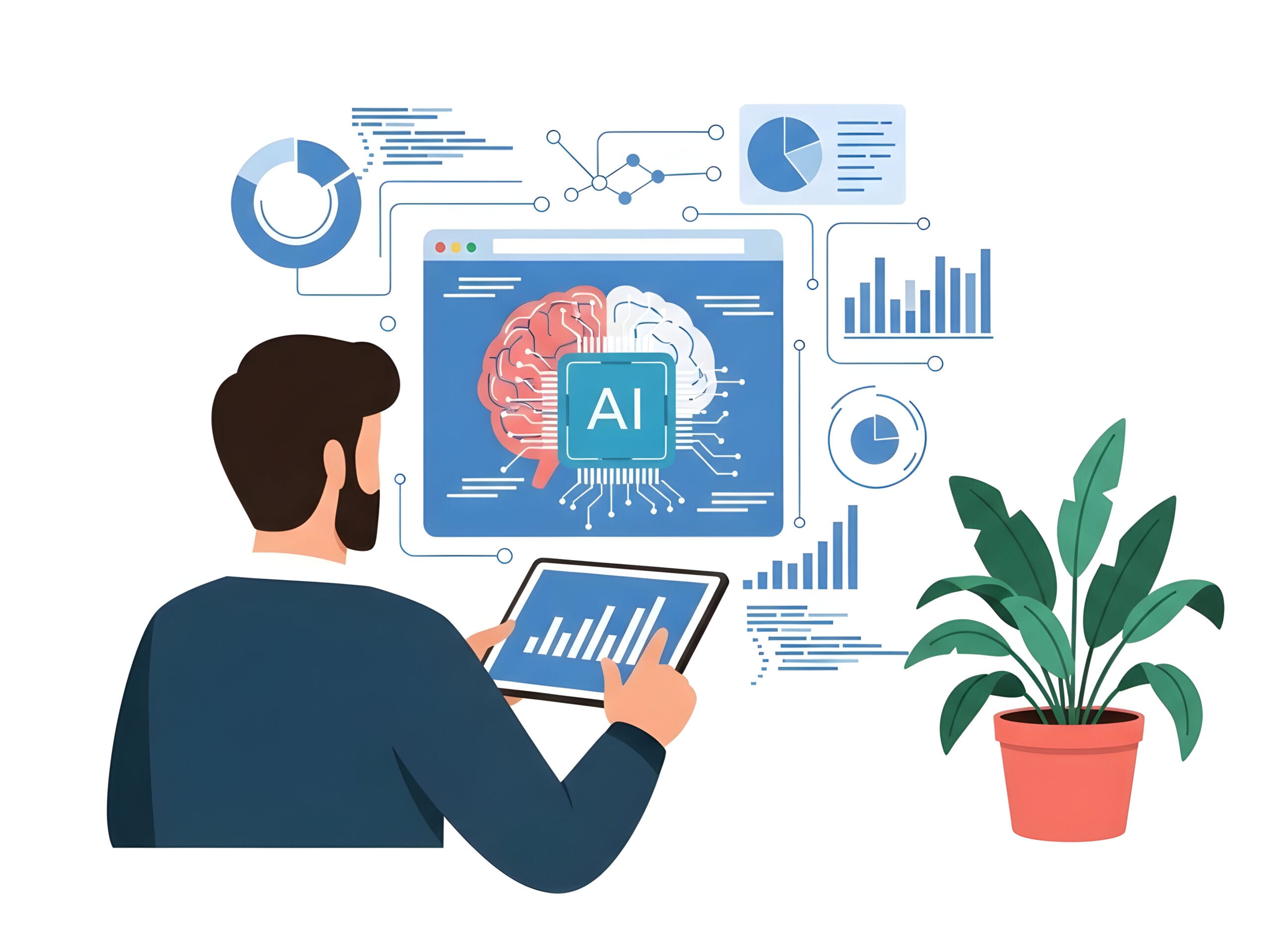
What Is Artificial Intelligence in Data Analysis?
Artificial Intelligence in Data Analysis refers to methods that help software recognize patterns, make predictions, process language, generate content, or assist with analytical tasks. It includes techniques such as machine learning, natural language processing, generative AI, anomaly detection, forecasting models, and AI-assisted automation.
Not every analysis needs an AI model. A pivot table, SQL query, or descriptive statistic may answer a business question more clearly and with less risk. AI becomes useful when the problem involves scale, complexity, prediction, natural language, repeated classification, or large volumes of information that would be slow to review manually.
How AI Is Changing the Data Analysis Workflow
1. Faster data exploration
AI assistants can help analysts generate exploratory questions, draft SQL or Python code, summarize distributions, and identify variables worth investigating. This can shorten the first stage of analysis, especially when the analyst already understands the dataset and can check whether the generated logic is correct.
2. More efficient data preparation
AI can suggest transformations, classify values, detect potential duplicates, explain errors, and help write cleaning rules. It does not remove the need to understand the data. A model cannot reliably decide whether a missing value is an error, an expected business condition, or a meaningful signal without context.
That is why data cleaning remains a core analytical skill. AI can reduce manual effort, but the analyst still has to define quality rules and verify the result.
3. Pattern and anomaly detection
Machine learning methods can detect patterns that are difficult to identify through manual review, including unusual transactions, customer segments, operational anomalies, or combinations of variables associated with a specific outcome. The finding is only the starting point. Analysts still need to test whether the pattern is stable, meaningful, and relevant to the decision.
4. Predictive analysis
Predictive models can estimate future demand, churn risk, payment behavior, equipment failure, or other outcomes using historical data. Their usefulness depends on the quality of the training data, the variables selected, the evaluation method, and whether the environment has changed since the model was trained.
5. Natural-language interaction with data
Generative AI has made it easier to ask questions in natural language, request explanations of a chart, summarize a report, or turn a business question into a draft query. This lowers the technical barrier to exploration, but it also creates a new skill requirement: analysts must give models enough context and define the expected output clearly.
For analysts using conversational AI, prompt engineering is most useful when it is treated as structured analytical communication rather than a shortcut around understanding the data.
6. Faster communication of findings
AI can help draft executive summaries, suggest chart explanations, adapt a message for different audiences, and identify where a report needs more context. The analyst remains responsible for the conclusion. A polished summary is not evidence that the underlying analysis is correct.
The same principle applies to AI data storytelling: automation can accelerate the presentation layer, while people still decide what the result means and what should be communicated.
Where AI Adds Value to Competitive Intelligence
Competitive intelligence is one area where AI can reduce the time spent sorting large amounts of external information. A team may need to review competitor websites, pricing changes, customer reviews, job postings, product launches, market announcements, and internal sales signals. AI can help organize and classify these inputs so analysts can focus on the changes that deserve attention.
- Monitor defined public sources and flag changes in products, pricing, positioning, or messaging.
- Cluster customer comments and reviews to identify recurring themes or shifts in sentiment.
- Compare competitor movements across time instead of reviewing each update in isolation.
- Generate scenario inputs for analysts to test, rather than treating generated scenarios as forecasts by default.
- Connect external market signals with internal sales, customer, or operational data to investigate possible impact.
5 Practical Applications of AI in Data Analysis
Demand forecasting
AI models can combine historical demand, seasonality, promotions, customer behavior, and selected external variables to estimate future demand. Analysts should compare model performance against a simple baseline before assuming that a more complex model is better.
Customer segmentation and propensity analysis
Machine learning can identify groups of customers with similar behavior or estimate the likelihood of churn, conversion, or repeat purchase. These outputs can support targeting, but teams still need to check whether the segments are interpretable and actionable.
Text and sentiment analysis
Natural language processing can organize reviews, survey comments, support messages, and other text into themes. For Arabic data, dialect, context, sarcasm, spelling variation, and domain-specific language can affect results, so local validation is especially important.
Anomaly and risk detection
AI can flag records that differ from normal patterns, such as unusual transactions, unexpected operating conditions, or sudden changes in behavior. A flag is not a diagnosis. It is a prompt for investigation.
Automated analytical assistance
Generative AI can help draft formulas, SQL queries, transformation steps, documentation, summaries, and explanations. The safest workflow is to use generated output as a draft, test it on known cases, and verify the logic before it enters a recurring report or decision process.
What AI Does Not Remove From Data Analysis
The strongest analytical workflows do not hand the entire process to a model. They make clear which parts can be accelerated and which parts require human control. Three responsibilities remain especially important.
- Question definition: AI cannot decide which business question matters most without clear goals, constraints, and context.
- Data quality: A model can process flawed data faster, but it cannot make unreliable data trustworthy simply by analyzing it.
- Validation and interpretation: Analysts must test outputs, investigate surprising results, compare alternatives, and explain uncertainty before recommending action.
AI Adoption Requires More Than a Tool
SDAIA’s Artificial Intelligence Adoption Framework evaluates readiness across leadership, data, human capabilities, technology and infrastructure, and AI governance. This is a useful model for analytics teams as well. If the data is not ready, the staff cannot evaluate the output, or governance is unclear, adding a more advanced model does not solve the underlying problem.
The UAE National Strategy for Artificial Intelligence 2031 follows a similar direction. It identifies talent, infrastructure, governance, and regulation as national enablers and gives priority to sectors including resources and energy, logistics and transport, tourism and hospitality, healthcare, and cybersecurity. The UAE strategy reinforces a practical point for learners: AI skills are most useful when they are connected to a specific operational or business problem.
Which AI Skills Should a Data Analyst Learn?
An analyst does not need to become a machine learning engineer to benefit from AI. A stronger starting point is to build the analytical foundation first, then add AI where it improves the workflow.
- Data literacy and statistics, so you can judge whether a result is plausible.
- Excel, Power Query, Power BI, and SQL for preparing, modeling, querying, and reporting business data.
- Basic understanding of machine learning concepts such as training data, features, evaluation metrics, overfitting, and model drift.
- Prompting and AI-assisted analysis for generating drafts, exploring alternatives, and accelerating repetitive analytical tasks.
- Validation skills, including checking calculations, comparing outputs with known cases, and documenting assumptions.
- Data storytelling and business communication, so insights can be explained without overstating what the model proves.
A Practical Way to Use AI During an Analysis
- Define the business question and the decision the analysis needs to support.
- Inspect and clean the data before asking AI to interpret it.
- Use AI to accelerate a specific task, such as drafting a query, classifying text, proposing features, or summarizing findings.
- Validate the output against the source data, known cases, and a simpler analytical method where possible.
- Document assumptions, uncertainty, and any AI-generated steps that materially affect the result.
- Communicate the finding in business terms and separate observed evidence from model-generated suggestions.
Build AI Skills on a Strong Data Analysis Foundation
Artificial intelligence can make analysts faster, but it is most useful when the analyst already understands data preparation, querying, statistics, visualization, and business interpretation. IMP’s Data analysis training courses develop that foundation through Excel, Power Query, Power BI, SQL, descriptive statistics, data storytelling, automation, and competitive intelligence. This gives learners the context needed to use AI as part of an analytical workflow rather than as a substitute for one.
If you want to understand the diploma structure, available schedules, and the learning path that fits your experience, contact the IMP team for the current program details.